
Horseless Carriages
Amar Pandit
A respected entrepreneur with 25+ years of Experience, Amar Pandit is the Founder of several companies that are making a Happy difference in the lives of people. He is currently the Founder of Happyness Factory, a world-class online investment & goal-based financial planning platform through which he aims to help every Indian family save and invest wisely. He is very passionate about spreading financial literacy and is the author of 4 bestselling books (+ 2 more to release in 2020), 8 Sketch Books, Board Game and 700 + columns.
October 22, 2021 | 2 Minute Read
I am so fascinated by this headline (and change as a subject) that for the first time in almost 2 years, I am publishing the same post in both of my blogs www.happyrichinvestor.com and www.happyrichadvisor.com
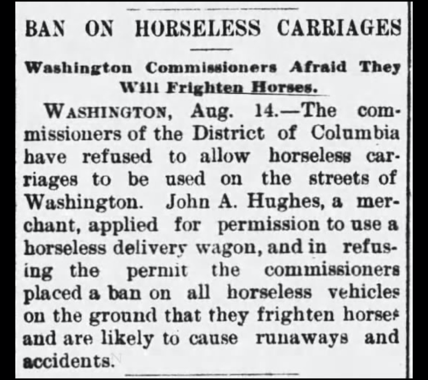
Take a look at the image below. It is a real newspaper cut-out from the early 1900’s. Pessimist Archives does a wonderful job of curating these. By the way Pessimism is a Real Business Model but that’s a topic for another day. Reread the contents of the image carefully.
Can you believe this?
Just to be clear, Horseless Carriages = Cars
Washington Commissioners were afraid that Horseless Carriages (aka Cars) will Frighten Horses, thus a Ban on Them.
We might even laugh while reading the above, but the reality is that this is how society in general responds to new technology.
Don’t believe it yet?
Just 25-28 years back, the Internet was seen a fad and meant for gambling and pornography.
Additionally, a Nobel Prize Winner in Economics, Paul Krugman, wrote in 1998, “The growth of the Internet will be slow drastically, as the flaw in “Metcalfe’s law” -which states that the number of potential connections in a network is proportional to the square of the number of participants- become apparent: most people have nothing to say to each other! By 2005 or so, it will become clear that the Internet’s impact on the economy has been no greater than the fax machines.”
Well, you know the answer to the impact of the internet on our lives.
So how do we protect ourselves from falling into this trap of resisting change?
The Greek Stoic philosopher Epictetus has the answer. He said, ‘We should get into the habit of asking ourselves,’ “What illusion about myself do I entertain? Do I, too, ever make that boast about being prepared for whatever may happen? If I don’t know something, am I properly aware that I don’t know it?”
It’s only when you are truly aware that you don’t know (and what you don’t know) will you ever make an attempt to seek the truth or look out for someone who can really help you.
Similar Post
Nano Learning
Service versus Hospitality
In his book,"Unreasonable Hospitality" Restaurateur Will Guidara, wrote about a question he asks everyone. “What’s the difference between service and hospitality?
4 October, 2024 | 2 Minute Read
Nano Learning
The Weakest Link Continued
Thanks so much for all your lovely responses.
There were different responses such as
-Process or Method of reaching prospects effectively
-Negativity in media about distributor ....
Read More
25 June, 2021 | 3 Minute Read
Nano Learning
The Shangchi Dialogue
I recently saw the latest Marvel gem "Shangchi".
This was the first Marvel movie (besides Black Panther) I did not sleep in. I know my daughters and all Marvel fans will hate me f ....
Read More
17 September, 2021 | 2 Minute Read
Nano Learning
Become a World Class Editor
Scientific American recently had a post with this headline “Our Brain overlooks this Brilliant Problem-Solving Strategy”.
One of the key points of the post was “People of ....
Read More
23 April, 2021 | 3 Minute Read
Nano Learning
2 Hours Quality Conversation > 13 years of Transactional Relationship
How many of you believe this to be true?
Well I can Guarantee that it is.
An IFA from Bengaluru got an experience of his lifetime when he acquired a new client (virtually) with a ....
Read More
31 July, 2020 | 2 Minute Read
Nano Learning
It’s Priority
In his book “Essentialism – The Disciplined Pursuit of Less”, Greg McKeown wrote,
“The word priority came into the English language in the 1400s. It was singular.
Priorit ....
Read More
27 January, 2023 | 2 Minute Read


- 0
- 0
0 Comments