
The Real Use of AI
Amar Pandit
A respected entrepreneur with 25+ years of Experience, Amar Pandit is the Founder of several companies that are making a Happy difference in the lives of people. He is currently the Founder of Happyness Factory, a world-class online investment & goal-based financial planning platform through which he aims to help every Indian family save and invest wisely. He is very passionate about spreading financial literacy and is the author of 4 bestselling books (+ 2 more to release in 2020), 8 Sketch Books, Board Game and 700 + columns.
March 20, 2026 | 2 Minute Read
AI is supposed to free up our time.
That is the promise.
Automation will reduce manual work.
Reports will generate themselves.
Research will become faster.
Communication will become easier.
Operations will become smoother.
In theory, this should give you something extremely valuable.
Time.
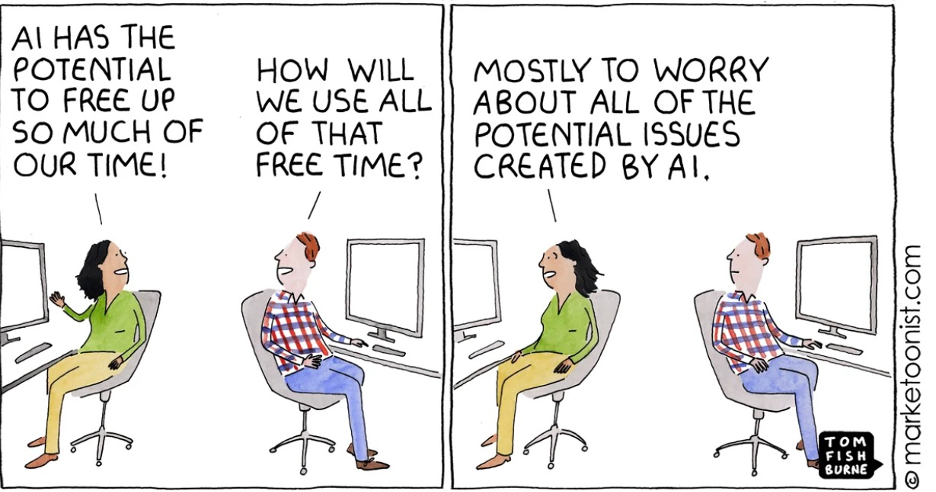
But here is the strange irony captured in this sketch.
Instead of using that time wisely, many professionals are spending it worrying about AI itself and on many unproductive activities.
Will AI replace advisors?
Will clients stop needing us?
Will technology make my work irrelevant?
Will platforms dominate everything?
The conversation has become dominated by fear.
But this is the wrong way to think about it.
AI is not replacing the core of what great financial professionals do.
Because the most valuable part of your work was never calculation.
It was judgment.
It was never data processing.
It was understanding people.
It was never product comparison.
It was guiding behavior.
The real work of a financial professional happens in conversations where clients are confused, anxious, emotional, or uncertain.
When markets fall (like what you are experiencing now).
When families argue about money.
When a client wonders if they have enough.
When someone asks whether they can retire.
No machine can sit across the table and truly understand those emotions.
What AI can do is remove friction.
It can automate repetitive work.
It can organize information.
It can help you prepare faster.
And that is incredibly powerful.
Because if AI frees up your time, the most important question becomes:
What will you do with that time?
You could spend it worrying about technology.
Or you could spend it becoming a far better professional.
You could deepen relationships with clients.
You could understand their lives more closely.
You could design better financial journeys.
You could think more deeply about behavior, trust, and long-term outcomes.
Technology will keep evolving.
But the wealth professionals who thrive in the future will not be those who compete with AI.
They will be those who use AI to become more human in their work.
Because ultimately, clients are not looking for better spreadsheets.
They are looking for someone who helps them make better decisions about their lives.
Similar Post
Nano Learning
Build the Business Your Clients Deserve
Your clients have trusted you for years.
They’ve followed your advice.
They’ve grown their wealth.
And they believe in you.
But here’s a question most advisors never ask:
Am ....
Read More
20 June, 2025 | 1 Minute Read
Nano Learning
Chief Change Officer
When I ask IFA’s to state their problem, the first thing most people say is GROWTH. I tell them “Growth is not your Problem; Growth is the Result of your Problem.”
Let us sa ....
Read More
7 August, 2020 | 2 Minute Read
Nano Learning
6 Powerful Words to grow your Business
∙ Get Better Clients ∙ Have Better Pricing
14 May, 2021 | 1 Minute Read
Nano Learning
The Billionaires’ Blueprint: Acting Now to Shape the Next Decade
The reason you are seeing success today is because of something you did 10 or 15 years ago. You planted a seed then...It’s now grown into a tree. Isn’t it right?
2 February, 2024 | 2 Minute Read
Nano Learning
The Good Endures: From Roman Philosophy to Modern Finance
There is an interesting lesson on long-term thinking by the Roman philosopher Musonius Rufus. I don’t recollect where I had read it but it’s so good that I had to share it with ....
Read More
16 February, 2024 | 2 Minute Read


- 0
- 0
0 Comments