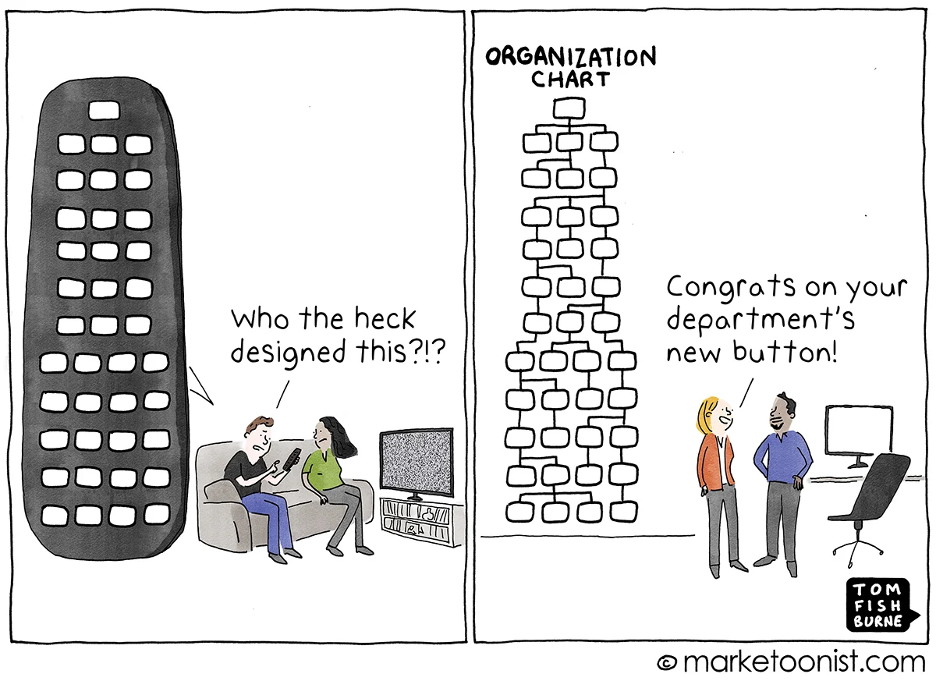
I came across the cartoon above a few days ago and was blown away with it.
On the left is an old television remote control covered with what feels like a hundred different buttons. The person holding it looks completely confused and asks, “Who on earth designed this?”
The second panel quietly provides the answer.
A huge organization chart and someone proudly saying, “Congratulations on your department’s new button.”
I laughed. Then I realized it wasn’t really a joke. It was a remarkably accurate description of how many organizations end up building products, services and client experiences.
Several decades ago, computer scientist Melvin Conway made an observation that later became famous as Conway’s Law.
His insight was beautifully simple.
Any organization that designs a system will ultimately produce a system that mirrors the way the organization itself communicates.
In other words, your customers eventually experience your organization chart, whether they know it exists or not. The more I observe our profession, the more convinced I become that Conway’s Law explains far more than technology.
It explains client experience.
Imagine a successful solo financial professional with three or four support staff. The phone rings constantly. A client wants to redeem an investment. Another needs a capital gains statement. Someone has forgotten their SIP date. A prospective client has arrived early for a meeting. The back office is chasing KYC documents. Compliance needs a signature before the end of the day. An employee walks in with a question that only the founder seems able to answer. Every few minutes, another interruption quietly pulls the financial professional away from the conversation he was trying to have. By evening, everyone has worked incredibly hard, yet almost nobody feels they made meaningful progress on the work that truly mattered.
Now imagine being the client walking into that office. You don’t see dedication, experience or good intentions. You simply experience waiting. You repeat information that somebody else in the firm should already know. You are asked to sign forms that seem disconnected from the conversation you just had. The financial professional apologizes because he has to take “just one quick call,” which inevitably turns into five minutes. None of these moments, taken individually, appears particularly significant. Collectively, however, they shape your perception of the entire firm. The client may never see the organization chart, but they experience it in every interruption, every delay and every handoff that doesn’t feel seamless.
The fascinating part is that the problem is rarely the people. More often, it is the way the business has evolved. As clients increased, new responsibilities were simply layered onto the founder instead of being thoughtfully redistributed across the organization. The financial professional remained the investment committee, the operations head, the compliance officer, the relationship manager, the recruiter, the trainer and often the technology department as well. From the inside, it feels like commitment. From the outside, it feels like complexity. That, in many ways, is Conway’s Law playing out in real life. The structure of the business quietly becomes the structure of the client experience.
Now, imagine a client walking into a large wealth firm.
The investment team discusses portfolios. The insurance specialist focuses on protection. The tax consultant explains tax efficiency, while the estate planner begins talking about wills and succession. Before long, the banker introduces structured products, and the relationship manager does his best to coordinate the entire conversation. Every individual around the table is intelligent, experienced and trying to help. Every department performs its role competently and viewed in isolation, each conversation makes perfect sense. Yet by the time the meeting ends, the client walks away feeling strangely overwhelmed rather than reassured.
The reason is rarely a lack of expertise. It is that nobody appears to own the whole experience. Every interaction feels like another department doing its job instead of one organization solving one family’s problem. The client didn’t come looking for an investment team, an insurance team, a tax team or an estate planning team. They came looking for clarity. They wanted one thoughtful conversation about their life, their family and their future. Instead, they experienced the organization exactly as it existed internally, a collection of specialized functions that happened to share the same office. The client may never see your organization chart, but they feel it in every fragmented conversation, every handoff and every moment when the whole seems far less than the sum of its parts.
This is where Conway’s Law becomes incredibly relevant.
If your investment team rarely speaks to your insurance team…your client experiences that disconnect.
If compliance creates one process…operations creates another…technology creates a third…and financial professionals invent a fourth…your client experiences that fragmentation.
If every department optimizes only for its own success…the client ends up navigating the organization rather than receiving a seamless experience.
Customers never study the organization chart. They simply experience it.
One of the reasons we have invested so heavily in building our Financial Cafes is precisely because we wanted to challenge this way of thinking.
We weren’t trying to redesign an office. We were trying to redesign conversations.
The physical environment changes how people interact. It encourages families to stay longer. It encourages financial professionals to ask better questions. It encourages collaboration across functions instead of isolated meetings.
The space itself becomes part of the client experience.
Most people think architecture is about buildings. I have come to believe it is equally about behavior. The same principle applies to technology.
Many firms proudly describe themselves as “technology enabled.” That sounds impressive until you ask a simple question.
Is the technology connecting your organization or merely digitizing your silos?
You can have outstanding CRM software…excellent portfolio software…great financial planning software…AI…workflow systems…document management…and still deliver a fragmented client experience.
Technology amplifies organizational design. It rarely fixes poor organizational design.
I think this explains why some firms feel effortless to clients while others feel exhausting.
The difference is rarely intelligence nor is it effort. It is integration. Some organizations spend years reducing friction between departments before clients ever notice. Others unknowingly ask clients to become project managers, coordinating conversations between teams that should already be speaking to each other.
The irony is fascinating.
Most firms spend enormous amounts of time redesigning products. Far fewer spend time redesigning how their own people communicate. Yet Conway understood something almost sixty years ago that remains remarkably relevant today.
The product eventually becomes a reflection of the organization that created it. The same is true of the work we do. The same is true of client experience and the same is true of culture.
Whenever a client tells you, “Your process feels complicated,” they may be describing your communication. Whenever they say, “I had to repeat myself three times,” they may be describing your organization. Whenever they feel different parts of your firm aren’t aligned…they are experiencing Conway’s Law.
The key question to ask yourself, “How do we improve the way our own people work together?”
Clients never see your weekly meetings.
They never see your internal disagreements.
They never see your organization chart.
Yet somehow…they experience every single one of them.
Every organization eventually exports its internal conversations into the lives of its customers.
The question, therefore, is not whether your clients experience your organization. They already do.
The real question is this…
Is the organization they experience the one you intended to build?
On that note, I wish you and your family a very Happy Ganesh Chaturthi. May Ganpati Bappa shower his love and blessings on all of you 🙏♥️








0 Comments